

In Defense of Reading
Recently, The Atlantic released an article detailing the decline in full-length reading requirements at both the high school and university levels. The author, Rose Horowitch, chronicles how fewer and fewer students at “elite” colleges are able to complete full-length reading. Why is this? Many have graduated from high schools where they weren’t required to read a full-length novel.
The article points out a few different causes for this shift, such as standardized testing and smartphones.
Nowadays, reading expectations at colleges are bemoaned and even serve as the butt of famous jokes. Just look at one of John Mulaney’s famous monologues about his English degree.
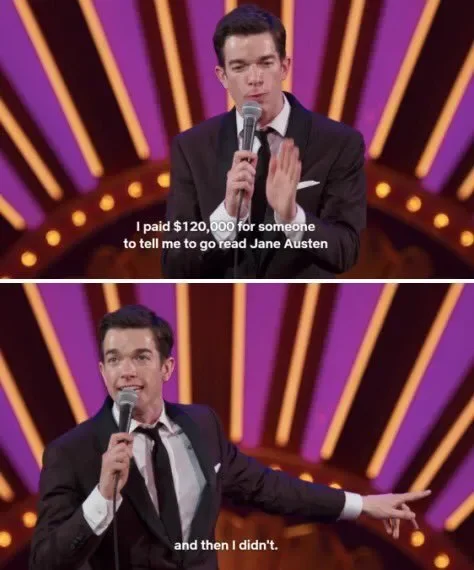
Source: Pemberley Digital on Tumblr
As a lover of books who wields an English degree, I’m horrified, yet not surprised.
The attention economy’s out to get you.
Not too long ago, I read that a study came out saying that humans have a shorter attention span than a goldfish. With the advent of technology in our lives, TikToks, Reels, and other short-form soundbites are eroding our collective ability to pay attention. No wonder books seem so daunting!
If you find yourself struggling to fight through a long form article, this isn’t a condemnation; you are not alone! I’ll admit that getting all of my initial thoughts down for this article was tough. When clicking through my research and jotting down my ideas, I had to fight the urge to scroll through my Instagram feed or dawdle —yes, dawdle — on some random app. Resistance is everywhere, and nearly everything we engage with fights its hardest for your precious attention.
Reading can and will change your life.
Saint Augustine famously heard a voice calling to him, saying, “Tolle et lege” (Pick up and read!) He responded to the call, and through his reading of Scripture, the Church gained a spiritual powerhouse who continues to inspire people with his life story, chronicled in Confessions.
Frederick Douglass was similarly impacted by the power of reading. His White counterparts were threatened by the fact he could read, yet read he did.
Douglass is quoted to have said:
“Once you learn to read, you will be forever free.”
The radical decision to read paved the way for one of America’s pivotal players to shed insight on the grave evils of his time … and readers were moved to action that made our country better.
Truly, we are losing out on such richness — and a myriad of perspectives — when we don’t embrace reading and the full picture. Books offer viewpoints other than your own, challenging you to think critically and consider the experiences that inform the way you view the world.
My favorite literary giant, C.S. Lewis, had this to say about reading:
“In reading great literature I become a thousand men and yet remain myself.”
Part of the reason I’m so surprised that academia is sliding away from the longer reading requirements is because there is so much more one can learn by sticking it through an entire story, fiction or otherwise. “Books can cultivate a sophisticated form of empathy... that skimming or reading in short bursts does not,” Horowitch writes. There is so much depth people can attain from reading. Books allow you to not only walk, but settle into someone else’s shoes. In my humble opinion, there’s no other medium where you can experience that kind of perspective.
Throughout history, humankind has passed down information through storytelling. There’s something about stories that hook us, and we don’t merely roll over and let that info slide over us. In the act of reading, you engage with critical thinking skills, working to figure out character motivations in a novel, or even as session your own biases and perspectives on issues you encounter in nonfiction.
Plus, reading strengthens your writing. Who doesn’t want that?
Fight the power. Read books.
Ray Bradbury said this quite poignantly:
“You don’t have to burn books to destroy a culture. Just get people to stop reading them.”
On my own, I know I can’t turn the tide on what academia and colleges are starting to do. However, rather than roll over and just accept these lesser expectations on future generations, I’m inviting you to revisit reading.
Visit your local library or download apps like Libby or Hoopla. Pull out that paperback you’ve ignored on your bookshelf for far too long. Accompany your literary journey by listening to podcasts that dissect that book. With all of this information at our fingertips, use it to your advantage rather than letting it consume you.
Throughout history, it is reading that has unlocked so much potential. Don’t let the whims of this world take that away from you.