

No, You’re Not Getting Worse
Have you ever felt like a fraud?
You find yourself at a party, or idly participating in water-cooler talk at work. Someone asks what you do, and you go:
“Oh, I dabble in [insert activity here], but I’m…
Just getting started…
Just messing around…
Not sure how good my work is…”
Yet, years into your craft, you may still find yourself saying those same things, despite having put in the blood, sweat, and tears into improving yourself and your work.
I’ve been there. I’ve said all of the things. We might There may be a scientific explanation for it.
The Dunning-Kruger effect
Recently, my husband and I were watching a YouTube video when we stumbled across the concept of the Dunning-Kruger Effect. This phenomenon is attributed to people who think they are very skilled in a certain area, when they actually…aren’t.
Researchers observed this cognitive bias when assessing participants’ logic, grammar, and humor. Curiously enough, they found that participants who scored in the bottom quartile rated their abilities above average (makes me wonder what kind of jokes they told the researchers…)
Here’s a nifty visual I whipped up based on the Dunning-Kruger curve:
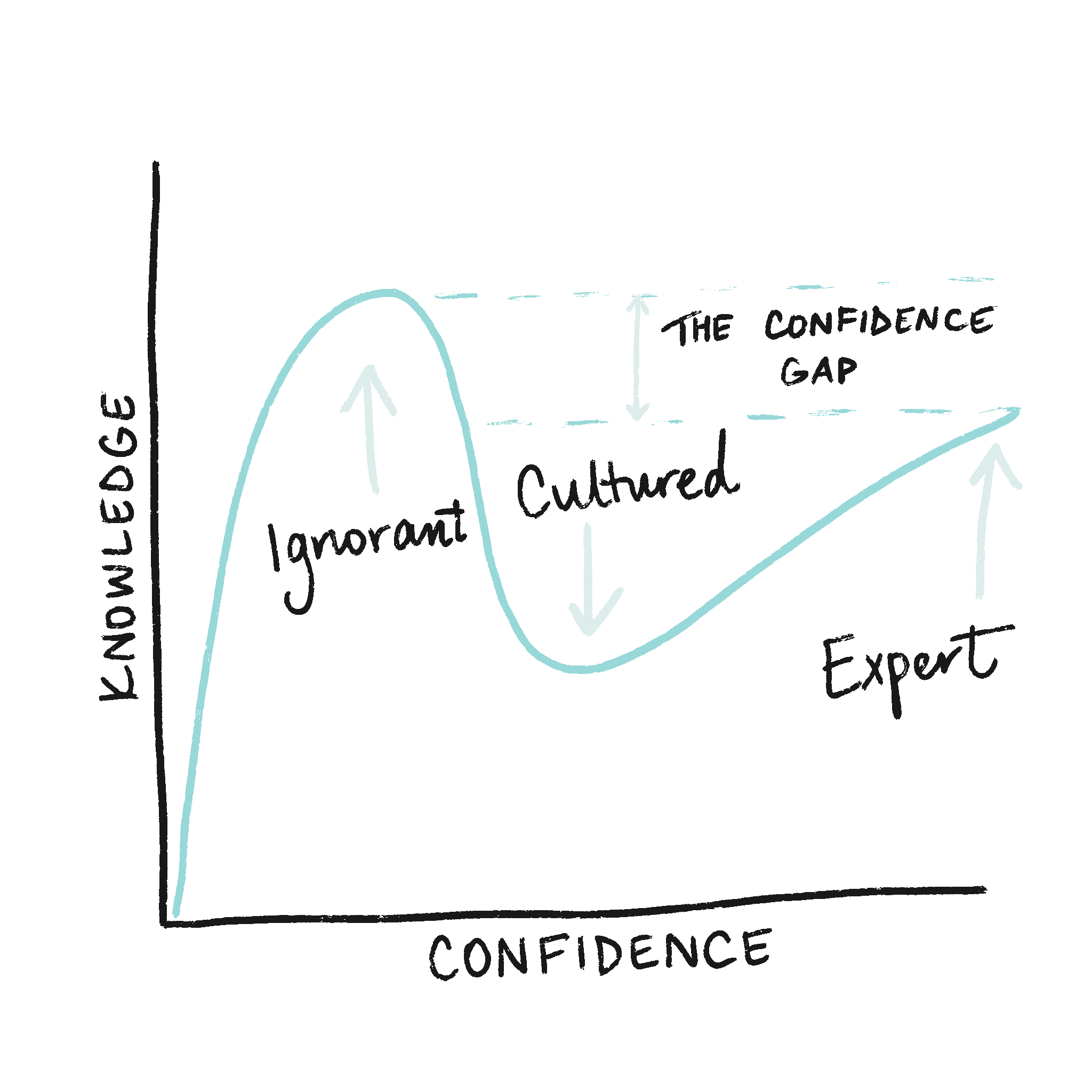
Curve illustration by yours truly.
Going deeper, Dunning and Kruger (the two researchers behind all of this) chalked up this disparity to a lack of self awareness; more specifically, a lack of metacognition. This, according to Psychology Today, is “the ability to step back and examine oneself objectively.”
Long story short: You don’t know what you don’t know… and you might not be aware of what you’re good at.
… and—hot take—I think humility can play a big part in this effect with skilled creatives.
It’s me, hi, I’m the problem
We creatives sure can be our own worst enemies.
Funnily enough, on the other side of the Dunning-Kruger effect is impostor syndrome. If people who think they’re all that really aren’t, then the converse, naturally, is thinking you’re a fraud (when you really aren’t!) *nervous chuckle*
It’s okay. Loads of people over the centuries have felt this way:
“God would never inspire me with desires which cannot be realized; so in spite of my littleness, I can hope to be a saint.” — St. Therese of Lisieux (spoiler alert: this twenty-something Carmelite nun ended up becoming a Doctor of the Catholic Church!)
“Painting and sculpture, labor and good faith, have been my ruin and I continually go from bad to worse. Better it would have been for me if I had set myself to making matches in my youth. I should not be in such distress of mind.” — Michelangelo (regarding what he considered to be the futility of his commissioned work)
Heck, even J.K. Rowling considered herself the biggest failure she ever knew, at one point in her life.
No matter where you find yourself on that Dunning-Kruger curve, there’s something to be learned. And in learning, you can fight back against those feelings of inadequacy that plague us all too often.
How to fight back
So, now that you know about these challenges that exist, what can you do about them?
Thankfully, you can do a lot! Here are just some of the ways you can stay humble and stay sharp in whatever it is you do:
Keep learning
One time at an art festival, I spoke with an artist who had sculptures meticulously made with natural materials. There was a simplicity and order to it all. I’d asked the artist how it was made, and he’d replied that his work was the culmination of hundreds of missteps and failed attempts. The result? A curated series of breathtaking sculptures.
It reminds me of this one quote from Thomas Edison:
I have not failed. I’ve just found 10,000 ways that won’t work.
Writers, keep reading. Artists, keep practicing. Woodworkers, keep…woodworking! (You get the idea.)
While I am a believer in the “done, not perfect” mentality, keep doing and doing and doing again, because with each iteration of your creativity, you are learning something from that experience.
Ask for feedback
Talk to a trusted person in your life and ask them to assess your work honestly. Consider what they have to say. Be humble in identifying areas where you can improve. No one on this planet is perfect, and realizing that you can grow is the first step in, well, growing. Iron sharpens iron, after all!
Take it to prayer
This one has helped me a lot. Everything we have, everything we are, it all goes back to Him. Why not bring your creative challenges to prayer? Asking for illumination in where you can grow, with humility, is a great place to start your journey.
And on that note of humility, a quote from my ol’ friend, St. Thomas Aquinas:
Humility means seeing ourselves as God sees us; knowing every good we have comes from Him as pure gift.
Take heart
So the moral is this: No, you’re not getting worse. You’re getting better, and through this growth, you’re learning. It’s like holding a candle in a dark room; you can only see so much around you, but then, you see what else there is to learn. And all of that only makes you stronger.
Years in, you may still find yourself struggling to shake off that feeling of inadequacy. Just a few weeks ago, I was there, too.
I was recently at a wedding, talking about my Substack with some friends I hadn’t seen in a while, explaining away my abilities as an amateur.
One of my friends stopped me in my tracks:
“You are a writer. And you are making a difference.”
Do your thing. Try, make mistakes, and try again. Keep doing. Do it well.